
 Eye-opening data from the U.S. Environmental Protection Agency (EPA) reveals that more than 158 million Americans – nearly half the population – are now exposed to toxic PFAS compounds, widely known as “forever chemicals,” in their drinking water.
While the red-flag findings – highlighted by the Washington-based Environmental Working Group (EWG) – have triggered concern across the United States, Swedish water tech and beverage pioneer Bluewater warns that this is not just an American crisis. The same threats are unfolding in tap and bottled water around the world.
“Let’s be clear: What’s happening in the U.S. is just the tip of the iceberg – it’s a planetwide threat to public health,” said Bengt Rittri, founder and CEO of Bluewater. “From forever chemicals to plastic particles, our drinking water is under siege. The world can’t afford to ignore this any longer.”
Pollution without borders
 PFAS, or per- and polyfluoroalkyl substances, are synthetic chemicals used in industrial applications and consumer products like non-stick cookware, firefighting foam, and food packaging. They resist degradation and accumulate in both the environment and the human body, posing risks including:
- Cancer
- Hormonal and reproductive disruption
- Immune system suppression
- Developmental harm in infants and children
The EPA’s new data underscore the scale of the problem in the U.S., but studies across Europe, Africa, Asia, and Latin America confirm PFAS contamination in rivers, reservoirs, and even bottled water.
In Europe, research by PAN Europe found trifluoroacetic acid (TFA) – a PFAS breakdown product – in 94% of tap water samples from 11 EU countries. Africa’s growing industrial zones are seeing similar contamination, particularly in South Africa, Nigeria, and Ghana, where regulatory gaps and outdated wastewater infrastructure compound the risks
Invisible Threat Lurking in Every Glass
Alongside PFAS, microplastics – tiny plastic fragments from synthetic fabrics, packaging, tyres, and personal care products – have become an emerging global contaminant of concern. These particles, often smaller than 5 millimeters, have been found in:
- Over 80% of global tap water samples (based on a 2024 WHO review)
- 93% of leading bottled water brands, according to research from Orb Media
- Human blood, placenta, lungs, and breast milk – raising red flags about bioaccumulation and long-term health effects
“We’re drinking plastic – literally,” said Rittri. “And because microplastics carry toxic chemicals like BPA, phthalates, and even PFAS on their surfaces, the health implications are likely far greater than we currently understand.”
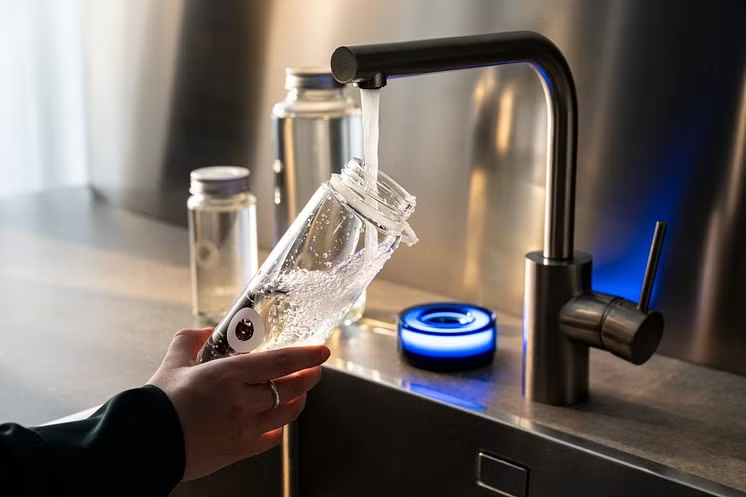 Bluewater’s compact under-sink water purifiers use the company’s second-generation reverse technology to deliver users water as clean as nature intended. Reverse osmosis (RO) is the gold standard for purifying tap water, removing up to 99% of contaminants like heavy metals, chemicals, bacteria, and microplastics. Bluewater’s proprietary SuperiorOsmosis™ technology takes RO further – offering a second-generation solution that increases water recovery, cuts energy use, and slashes wastewater. It’s a powerful, sustainable upgrade for homes and businesses alike.
The Bluewater SuperiorOsmosis™ technology, available in both consumer and commercial systems, has been independently tested and verified to:
- Remove up to 99.99% of PFAS compounds
- Effectively eliminate microplastics down to submicron levels
- Filter out heavy metals, pharmaceuticals, chlorine, nitrates, and more
Bluewater high-performance water purifiers are used in homes, schools, offices, restaurants, hotels, and at major sporting events across more than 50 countries. Unlike traditional filters, Bluewater systems combine reverse osmosis, activated carbon, and advanced membrane purification for unmatched performance – without the environmental cost of plastic water bottles.
“With Bluewater, people can take back control of the water they are drinking,” said Rittri. “Our mission is to make clean, safe drinking water a reality – whether you live in Stockholm or São Paulo, Paris,Cape Town or Los Angeles.”
Need for global action
Bluewater urges governments, water authorities, businesses, and individuals to treat the global water crisis with the urgency it demands:
- Governments must introduce or tighten PFAS and microplastics regulations.
- Water utilities need investment to modernize testing and treatment.
- Consumers must take steps to protect their households using verified purification technologies – and demand accountability from polluters.
“Access to clean drinking water is not a luxury. It’s a human right,” Rittri emphasized. “And it’s one we must all fight for – together.”
Find out more about Bluewater’s world-leading water systems and technology here: Bluewater Group